


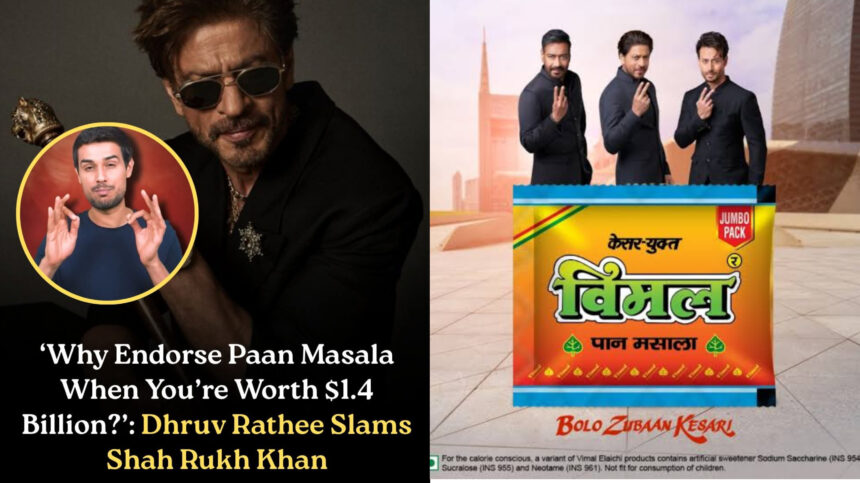
October 16, 2025 | A new debate on ethics and influence is raging online after YouTuber Dhruv Rathee questioned Bollywood superstar Shah Rukh Khan for endorsing a paan masala brand, despite being one of the richest entertainers in the world.
In a video shared on X, Rathee pointed out the irony of a man worth $1.4 billion (around ₹12,400 crore) lending his face to a product that contributes to serious health issues. He discussed Khan’s spending habits, influence over millions of fans, and the moral dilemma behind celebrity advertising choices.
Rathee’s remarks reignited a long-standing public criticism — the double standards of Indian celebrities, who often promote health and fitness on one hand, yet endorse addictive or harmful products on the other.
Over the years, stars like Amitabh Bachchan, Akshay Kumar, Ajay Devgn, and Ranveer Singh have faced similar scrutiny for associating with tobacco-linked or questionable lifestyle brands. While some have withdrawn after backlash, others have continued, citing “business commitments.”
The incident has once again raised a difficult question:
Should influence come with accountability?
In an era where fame is currency, Rathee’s critique hits at the core of celebrity culture — when does brand promotion become moral compromise?
For now, social media remains divided — between those defending Shah Rukh Khan’s right to commercial choices, and others echoing Rathee’s view that true icons should know where to draw the line.